
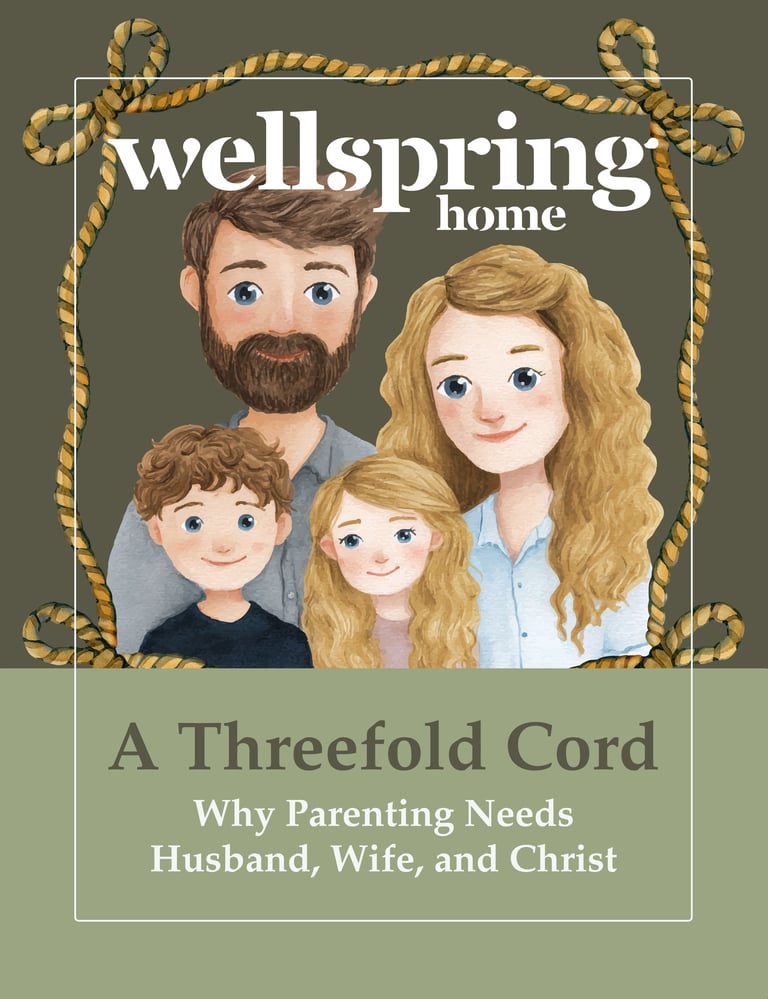
A Threefold Cord: Why Parenting Needs Husband, Wife, and Christ
MARRIAGEPARENTING
Regina
2/13/202617 min read
We are raising children in a generation increasingly shaped outside of God’s created order. Many children today are born and raised apart from the covenantal structure of marriage, removed from the environment God designed for their nurture and flourishing. This cultural shift presents real challenges for Christian parents who seek to remain faithful to the Scripture rather than conform to prevailing norms.
Yet even amid this decline, God’s ordinary means of grace remain powerful. The Scripture and history affirm what research also reflects: faith is most often formed in the home. God commonly uses parents as the primary instruments through which children come to know Him. This reality underscores both the privilege and the weight of Christian parenting.
From the beginning, God did not design parenting as a solitary task. Family life was created as a covenant partnership with the husband and wife united in marriage, laboring together under the lordship of Christ. This order reflects the wisdom of Ecclesiastes 4:12: “A threefold cord is not quickly broken.” When marriage is strengthened by Christ at its center, the home becomes a place of stability, discipleship, and visible gospel witness. Children do not merely hear about God’s design; they watch it lived out before them.
Though cultural attitudes toward marriage and family continue to shift, God’s blueprint for parenting has not changed. Children still need the faithful presence of both father and mother. Each parent brings distinct gifts and callings to the work of discipleship. Above all, Christ must be the binding cord, holding the marriage together, ordering the home, and giving eternal weight to the daily faithfulness of raising children in the fear and admonition of the Lord.
The Biblical Image of the Threefold Cord
Solomon’s wisdom in Ecclesiastes gives us more than a poetic observation. It reveals a theological reality woven into God’s design for human relationships. “A cord of three strands is not quickly broken” (Ecclesiastes 4:12) speaks to the strength that comes from a God-ordained unity. While often quoted sentimentally, this image carries huge implications for marriage and parenting.
The threefold cord points to a bond formed when husband and wife are joined together under the sovereign rule of God. It is not merely relational strength that Solomon commends, but stability rooted in God’s order. When God Himself is the binding strand, marriage and family life gain a resilience no human effort alone can produce.
Why Marriage and Parenting Are Spiritually Linked
Marriage and parenting are not separate callings accidentally joined by circumstance. The Scripture presents them as spiritually connected, flowing from the same covenantal design. Marriage establishes the context in which godly parenting ordinarily flourishes. It is the soil from which faithful discipleship in the home grows.
From the beginning, God designed families to reflect spiritual realities. Humanity was created in God’s image, and family life mirrors that truth. Earthly families serve as living parables of God’s heavenly family. This elevates marriage and parenting beyond social arrangements. They are sacred callings meant to display God’s character, faithfulness, and love.
The Apostle Paul makes this connection explicit in Ephesians 5, where he teaches that marriage mirrors the covenant relationship between Christ and His Church. A husband’s sacrificial love and a wife’s faithful response point to the gospel itself. This reality reshapes how Christian parents understand their responsibilities: marriage and parenting are not primarily about personal fulfillment, but about faithful representation of Christ.
When marriage and parenting are separated or weakened, children bear the consequences. A child’s earliest understanding of authority, love, faithfulness, and grace is shaped within the home. Parental unity matters because it provides a coherent picture of God’s nature—steadfast, loving, and trustworthy.
God’s Design for Strength Through Unity
Solomon’s words build intentionally: “Though one may be overpowered, two can defend themselves. A cord of three strands is not quickly broken.” The progression matters. Isolation leaves a person vulnerable. Partnership brings strength. But God’s presence brings enduring stability.
This metaphor reveals multiple layers of biblical truth.
First, it affirms the practical strength of unity. God designed people to need one another. Shared burdens, mutual protection, and cooperation are gifts, not weaknesses.
Second, it points to spiritual necessity. The movement from two to three strands highlights that human relationships reach their fullest strength only when God Himself is central. Marriage and parenting gain supernatural endurance when ordered under His authority.
Third, it reflects a consistent biblical pattern. God often works through relational structures marked by unity and dependence—from Abraham, Isaac, and Jacob, to Moses supported by Aaron and Hur, and ultimately to the perfect unity of the Trinity: Father, Son, and Holy Spirit. The threefold cord finds its ultimate expression in God Himself.
Marriage and Parenting as a Covenant
An understanding of marriage begins with a covenant, not a contract. This distinction greatly shapes how Christians should approach family life.
A contract is built on mutual benefit and conditional commitment. A covenant is rooted in steadfast faithfulness and sacrificial love, witnessed by God Himself. Marriage, as the Bible presents it, is a covenant that reflects God’s unwavering commitment to His people.
The contrast is clear:
Contracts ask, “What do I receive?” Covenants ask, “How can I give?”
Contracts allow exit clauses; covenants endure through hardship.
Contracts depend on performance; covenants persist through failure.
Contracts focus on rights; covenants emphasize responsibility.
Parenting reveals the covenantal nature of marriage more clearly than almost anything else. Faithful parents labor, sacrifice, and remain present regardless of circumstances. They mirror God’s own faithfulness to His children. When marriage covenants are broken, the pain runs deep because what God joined together has been torn apart. The Bible describes marriage as becoming “one flesh,” and division wounds far more than emotions; it fractures God’s intended unity.
Why Parenting Was Never Meant to Be a Solo Effort
From Genesis onward, the Scripture presents parenting as a shared calling. God entrusts children to families led by both father and mother, working together under His authority. This is not incidental; it’s intentional.
Children have complex physical, emotional, and spiritual needs. God, in His wisdom, involves two parents in every conception because parenting requires partnership. Each parent contributes distinct strengths that together form a fuller reflection of God’s care.
Deuteronomy 6:7 commands parents—plural—to diligently teach their children in every rhythm of life. Spiritual formation is not assigned to one parent alone. Both are accountable before God to disciple their children faithfully.
In this way, parenting reflects the Trinity itself—distinct persons, unified in purpose. Mothers and fathers differ in role and gifting, yet labor together toward the same end: raising children who know, fear, and love the Lord.
God’s Pattern for Shared Responsibility in the Family
The Scripture assigns clear parental responsibilities. Ephesians 6:4 calls parents to bring children up “in the discipline and instruction of the Lord.” This encompasses both loving nurture and faithful correction, where discipline is delivered with grace.
Fathers are called to provide spiritual leadership in the home. This leadership is not domineering but sacrificial, patterned after Christ’s love for the Church. It sets direction, establishes order, and bears responsibility before God.
Mothers bring essential nurture, wisdom, and relational strength that complete the partnership. Their attentiveness, encouragement, and care reflect God’s tender compassion for His people. Together, these complementary roles give children a fuller picture of who God is—both strong and gentle, authoritative and loving.
The Cost of Carrying Parental Authority Alone
Many believers find themselves parenting alone through circumstances beyond their control. The Bible does not minimize this burden. Carrying parental responsibility alone often brings exhaustion, uncertainty, and grief.
Yet the Bible also speaks of comfort to single parents. Your circumstances do not define your worth. Your identity is found in Christ alone. God draws near to those who parent without a spouse, revealing Himself as “Father of the fatherless and protector of widows” (Psalm 68:5).
God does not ask single parents to replicate a two-parent household. He calls them to faithfulness, not impossibility. The church is meant to step in as an extended family, and godly role models can help provide healthy examples where one parent is absent.
The threefold cord still holds. In single-parent homes, God Himself bears even more visibly the weight of partnership. With Christ as your constant presence and the support of His people, you are not parenting alone. His strength supplies what is lacking, and His grace is sufficient for every season.
Whether parenting alongside a spouse or carrying the load alone, the truth remains: when God is the binding strand, the cord does not break.
The Unique Contributions of Husband and Wife
God did not design the family with interchangeable parts. The Scripture reveals that husbands and wives are created equal in worth yet distinct in role, each bringing God-ordained strengths to the work of raising children. These differences are not shaped by culture or preference, but by God’s wisdom. When united under the lordship of Christ, the complementary callings of husband and wife create a home where children are formed, protected, and discipled according to God’s design.
The family is meant to display God’s character to the next generation. By design, children learn who God is not only through instruction, but through the lived witness of a father’s leadership and a mother’s nurture—two distinct expressions working together in harmony.
The Father’s Role as Spiritual Leader and Protector
The Scripture assigns fathers the primary responsibility for the spiritual direction of the home. This headship is not a call to domination, but to sacrificial service patterned after Christ Himself. Ephesians 5 teaches that a husband’s authority is exercised through self-giving love, not control.
Spiritual leadership places a weighty responsibility on fathers. A man’s life sets the spiritual climate of the home. His faithfulness, or lack thereof, shapes how children understand God, authority, repentance, and obedience. Headship, rightly understood, is not the easiest role in the family, but the heaviest one.
Fathers are called to model godliness through consistent spiritual disciplines, integrity of character, and humble repentance. The Bible commands fathers specifically: “Do not provoke your children to anger, but bring them up in the discipline and instruction of the Lord” (Ephesians 6:4). This instruction is not occasional or passive; it is deliberate, daily, and embodied.
God also calls fathers to protect. In a world filled with moral confusion and spiritual danger, a father’s steady presence provides security. His leadership creates boundaries that encourage growth and confidence rather than fear.
Perhaps most importantly, a father teaches his children how to love by loving their mother well. A husband’s faithful, visible love for his wife gives children a living picture of Christ’s love for His Church. The health of every family relationship is shaped first by the strength of this covenant bond.
The Mother’s Role as Nurturer and Teacher
The Scripture honors the essential and irreplaceable role of mothers in the formation of children. From infancy through adulthood, a mother’s nurturing presence provides stability, care, and instruction. Her influence is neither secondary nor sentimental; it’s foundational.
God entrusts mothers with the work of nurture, attentiveness, and instruction within the home. Through daily faithfulness, mothers shape the emotional, moral, and spiritual contours of their children’s lives. Proverbs repeatedly commends a mother’s wisdom and teaching as formative for a child’s future.
Through a mother’s tenderness, children learn that God is near, attentive, and compassionate. Her care teaches them that love is personal, patient, and steadfast. In the ordinary moments of listening, comforting, and instructing, mothers display God’s intimate knowledge of His children.
Mothers also serve as primary teachers, weaving wisdom into everyday life. Whether through conversation, correction, prayer, or example, they model what it looks like to walk faithfully with God. This daily instruction often shapes a child’s conscience long before formal teaching ever begins.
Leadership, Help, and Mutual Submission Under Christ
Biblical marriage flourishes where leadership and mutual submission coexist under Christ’s authority. Husbands are called to lead in love; wives are called to respond in respectful partnership. Both are called first to submit to Christ.
Submission in the Bible is not demeaning or coerced. It is a willing, faithful response to God’s order, rooted in trust and humility. Likewise, leadership is not self-serving authority, but sacrificial responsibility. When rightly understood, neither role diminishes dignity; both magnify Christ.
This ordered unity reflects the harmony within the Trinity itself. Father, Son, and Holy Spirit are equal in essence yet distinct in role, working together toward one purpose. In the same way, husbands and wives labor together with different strengths toward the shared goal of raising children who know and fear the Lord.
The home becomes a training ground for godly authority, not fear-based control, but loving guidance. Here, children learn that obedience is not oppressive, but protective; not degrading, but life-giving.
How Complementary Roles Reflect the Image of God
Neither father nor mother alone can fully reflect the character of God. Together, their distinct roles offer children a fuller picture of His nature.
Through a father’s leadership, children glimpse God’s authority, faithfulness, and provision. When a father keeps his word, protects his family, and leads with integrity, he reflects the God who never fails His promises.
Through a mother’s nurture, children experience God’s compassion, attentiveness, and care. Her willingness to listen, comfort, and know her children deeply mirrors the God who knows His people by name.
When both parents walk faithfully in their callings, children grow up with a balanced understanding of God—both His holiness and His mercy, His strength and His tenderness. When one influence is absent, that understanding is often incomplete.
God’s design is clear: families thrive when fathers and mothers embrace their distinct, complementary roles under Christ. When the threefold cord holds—husband, wife, and God—the home becomes a place where children are not merely raised, but discipled for the glory of God.
Keeping Christ as the Central Strand That Holds the Family Together
The strength of a family is not measured by routines, rules, or good intentions, but by whether Christ truly holds the center. In the image of the threefold cord, Christ is not an accessory strand woven in when convenient. He is the binding core. When parents relegate Jesus to the margins of family life, their efforts may appear successful for a season, but they lack enduring spiritual power.
Just as a rope weakens when its core strand frays, a family loses spiritual vitality when Christ becomes optional rather than essential. Parenting cannot bear the weight it was never meant to carry apart from Him.
Why Parenting Fails When Christ Is on the Periphery
When Christ is pushed to the edges of family life, biblical wisdom is soon replaced with cultural instincts. The Scripture is labeled restrictive or outdated, and parents are left to navigate complex moral and spiritual issues with human insight alone. Yet God’s Word consistently testifies that those who live under Christ’s lordship flourish, not perfectly, but faithfully.
Removing Christ from the center creates several spiritual burdens parents were never meant to bear. Without Him, wisdom from above is replaced with anxiety and self-reliance. Parents begin to shoulder the impossible task of securing their children’s spiritual future through their own performance. The Bible makes clear that salvation belongs to the Lord, not to parental effort (Jonah 2:9).
Children also notice when faith is compartmentalized. When Christ is acknowledged on Sundays but ignored in daily life, children learn that Christianity is optional rather than foundational. This inconsistency weakens their understanding of faith as a way of life. The Scripture warns of the consequences of spiritual neglect: “My people are destroyed for lack of knowledge” (Hosea 4:6). When Christ is not central, spiritual poverty quietly takes root and often extends beyond one generation.
Daily Practices That Keep Christ Central
Keeping Christ central does not require perfection or elaborate programs. It requires intentional rhythms that reflect dependence on Him. A Christ-centered home is not marked by constant religious activity, but by a steady awareness that all of life is lived before God.
Simple, faithful practices help anchor the family in Christ:
Family worship: Regular reading of the Bible, prayers, and conversations about God’s Word.
Mealtime gratitude: Giving thanks to God and speaking naturally about His provision.
Daily prayers: Beginning and ending the day by acknowledging dependence on the Lord.
Shared service: Practicing love for neighbor together as an outworking of faith.
Beyond planned moments, everyday life provides continual opportunities for discipleship. God’s creation, daily frustrations, acts of kindness, and moments of discipline all become teaching moments when parents intentionally point children to Christ. Faith is formed not only through instruction, but through interpretation. This helps children understand life through a biblical lens.
Prayer must permeate family life. A praying home confesses dependence on God rather than confidence in human strength. When parents pray openly and regularly, children learn that help, forgiveness, and wisdom come from the Lord.
How Christ Shapes Parental Authority and Grace
When Christ truly occupies the center of family life, He reshapes how parents understand both authority and grace. Parenting is no longer about behavior management alone, but about heart formation through the gospel.
Christ-centered parenting recognizes that only God changes hearts. Parents are called to shepherd faithfully, not to regenerate their children. As parents walk closely with Christ, their lives reflect the transforming power of the gospel. Children learn not merely from rules, but from watching repentance, faith, and obedience lived out daily.
This perspective transforms parental authority. Authority is exercised not through fear or control, but through loving leadership that reflects God’s own kindness and firmness. The Scripture teaches that God leads His people through truth and grace, not intimidation (Romans 2:4).
Christ models the perfect balance: “full of grace and truth” (John 1:14). Faithful parenting holds both together through clear boundaries rooted in biblical principles and abundant mercy grounded in grace. Correction addresses sin honestly, while the gospel proclaims identity in Christ more loudly than failure.
Christ also frees parents from the burden of perfection. When parents acknowledge their own sin, ask forgiveness, and pursue growth, children learn that following Jesus is not about flawlessness but about repentance and faith. This humility teaches grace far more powerfully than a flawless appearance ever could.
Teaching Children to See Christ in Everyday Home Life
God has designed parents to be their children’s primary disciplers. Long before formal teaching, children learn who God is by watching how their parents live, speak, and respond. Daily interactions become their first theology lessons.
Effective discipleship begins with simple, age-appropriate truths: God loves you. God is with you. God keeps His promises. As children mature, these truths deepen through explanation and application to real-life situations.
Parents can intentionally help children recognize God’s presence in ordinary moments—His creativity in nature, His kindness through others, His faithfulness in hardship. These connections teach children that God is not distant, but actively involved in every aspect of life.
This kind of discipleship requires parents to know Christ personally. The Bible exhorts believers to imitate those who follow Christ faithfully (1 Corinthians 11:1). Children are far more likely to walk with Jesus when they see their parents doing the same.
Faithful presence matters more than flawless execution. God delights to use small, ordinary acts of obedience to accomplish lasting spiritual fruit. Every prayer offered, every Scripture reading, and every gospel-centered conversation becomes a seed God Himself will grow in His time.
When Christ remains the central strand, the threefold cord holds firm. And through that strength, God faithfully works, often quietly, often slowly, to draw children to Himself for His glory.
When Unity Breaks Down: Recognizing and Repairing the Cord
Even in faithful Christian homes, the threefold cord can begin to fray. Sin, stress, fatigue, and unaddressed differences can strain the unity God designed for marriage and parenting. The Scripture does not deny this reality, but it does call parents to recognize signs of disunity early and respond with humility, repentance, and renewed dependence on Christ. Restoration is possible because God heals what sin has wounded.
Signs of Disunity in Parenting
Disunity between parents often reveals itself in subtle but damaging ways. Parents may contradict one another in front of their children, enforce inconsistent standards, or adopt a defensive “fortress mentality” where each spouse protects their position rather than pursuing peace. These patterns frequently arise from differing convictions about discipline, expectations, or methods. These are differences that even sincere, well-meaning believers experience.
When unity weakens, spouses often shift from seeking understanding to defending their own perspective. Instead of laboring together as one, they begin operating as separate authorities. This fracture does not remain between husband and wife; it spills into the life of the child.
Confusion, Insecurity, and Mixed Messages for Children
Children are perceptive observers. Even when parents attempt to conceal conflict, children sense tension and instability. When parental unity breaks down, children often internalize the conflict, assuming responsibility for what they cannot explain. This can produce insecurity, fear, or confusion about authority and safety.
Some children respond outwardly through defiance or acting out; others withdraw inwardly, becoming anxious or emotionally guarded. Over time, these coping patterns shape how children relate to authority, resolve conflict, and form relationships. God designed parental unity not merely for order, but for the emotional and spiritual security of children.
How Unresolved Marital Conflict Weakens Parental Leadership
When marital conflict remains unresolved, parental authority loses clarity and strength. Children struggle to trust a leadership that appears divided or inconsistent. The Bible repeatedly emphasizes the importance of unity in leadership. Division weakens witness, credibility, and direction.
A divided marriage often results in confused discipline, diminished respect, and increased behavioral struggles. Where peace is absent, children struggle to flourish. God’s design for leadership in the home depends upon the visible unity of husband and wife walking together under Christ.
Restoring Trust and Communication Between Spouses
The repair of unity begins with repentance and truth. Trust cannot be rebuilt through silence or avoidance, but through humble confession and renewed faithfulness. The Scripture calls believers to put off pride, speak truth in love, and pursue reconciliation diligently. Restoration often includes:
Honest confession of sin without self-justification
Tangible changes that demonstrate renewed faithfulness
Willingness to acknowledge and encourage growth in one another
Reorienting trust first and foremost toward God, who never fails
Practical steps may include intentional communication, accountability within the church, or wise pastoral counsel. Unity is not restored by control, but by obedience to Christ.
Rebuilding Unity Through Humility and Obedience
True unity flows from humility. The Scripture teaches that God “opposes the proud but gives grace to the humble” (James 4:6). Pride demands to be right; humility longs to be faithful. When parents choose humility, forgiveness becomes possible, and peace becomes attainable.
Obedience to Christ reshapes family dynamics. Instead of insisting on personal preference, spouses learn to yield for the good of the family and the glory of God. Where humility governs the home, conflict loses its power to divide.
Turning to Christ for Healing and Direction
Family division reminds us of a sobering truth: we cannot fix what only God can heal. Christ must remain at the center, not merely as an ideal, but as the living Lord who governs repentance, forgiveness, and renewal.
The Scripture warns against relying on human solutions apart from God’s wisdom. Like Peter, we are often tempted to “fix” situations according to our own understanding rather than submitting to God’s purposes. Healing begins when parents entrust their marriage, children, and disagreements fully to Christ’s care.
Strengthening the Threefold Cord in Everyday Family Life
The threefold cord is strengthened not through grand gestures but through daily faithfulness. God uses ordinary obedience to produce enduring fruit.
Families grow stronger when they:
Pray together regularly, asking God for wisdom and unity
Set aside intentional time to communicate without children present
Seek counsel from pastors or seasoned believers when disagreements persist
Share meals and routines that build shared identity
Model repentance and forgiveness openly
Celebrate God’s faithfulness, even in small ways
Biblical parenting calls both parents and children to something higher than individual preference—the good of the family and the glory of God.
A Strong Cord for a Lasting Legacy
Ecclesiastes 4:12—“a threefold cord is not quickly broken”—captures the wisdom of God’s design for marriage and parenting. Homes centered on Christ provide the strongest foundation for raising children who know and love the Lord.
When husbands and wives embrace their complementary roles under Christ’s authority, children witness a living picture of the gospel. Marriage becomes their first lesson in covenant love, authority, sacrifice, and grace. A strong marriage naturally strengthens parenting.
Mothers reflect God’s tender care through daily nurture, wisdom, and kindness. The Scripture honors this sacred calling: “She opens her mouth with wisdom, and the teaching of kindness is on her tongue” (Proverbs 31:26).
Fathers shape the spiritual direction of the home through faithful leadership and example. God speaks directly to this responsibility: “Fathers, do not provoke your children to anger, but bring them up in the discipline and instruction of the Lord” (Ephesians 6:4).
Above all, Christ must remain the central strand. Parenting strategies apart from Him will fracture under pressure. But when Christ governs the home, families find strength to endure trials, clarity to face opposition, and grace to persevere.
Children need more than effective techniques. They need to see genuine faith lived out by parents united under Christ’s lordship. This is how God passes faith from one generation to the next. His design for the family remains unchanging, resilient, and faithful when embraced in humble obedience to Him.
Subscribe to my newsletter for holistic homemaking tips and faith-filled inspiration for your home, your family, and your own personal walk in faith.
Join My Newsletter
© Copyright The Focused Homemaker, 2026. All Rights Reserved.
The Focused Homemaker
Encouragement for the wife, mother, and homemaker you actually are, one pillar at a time.